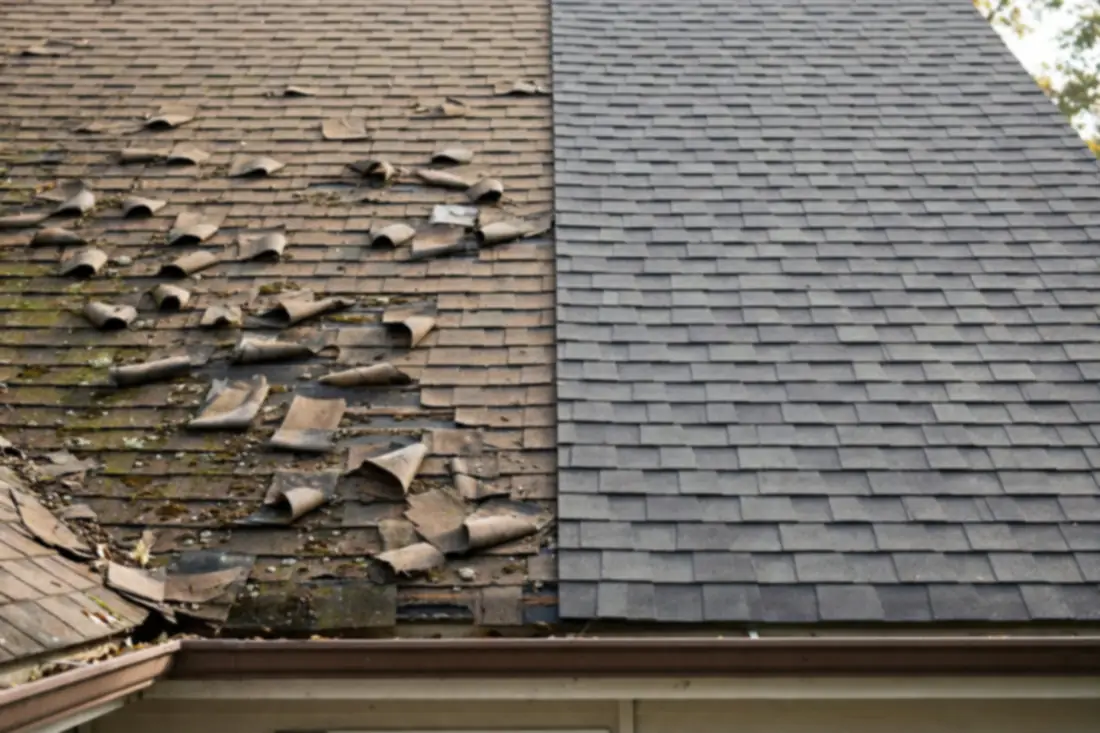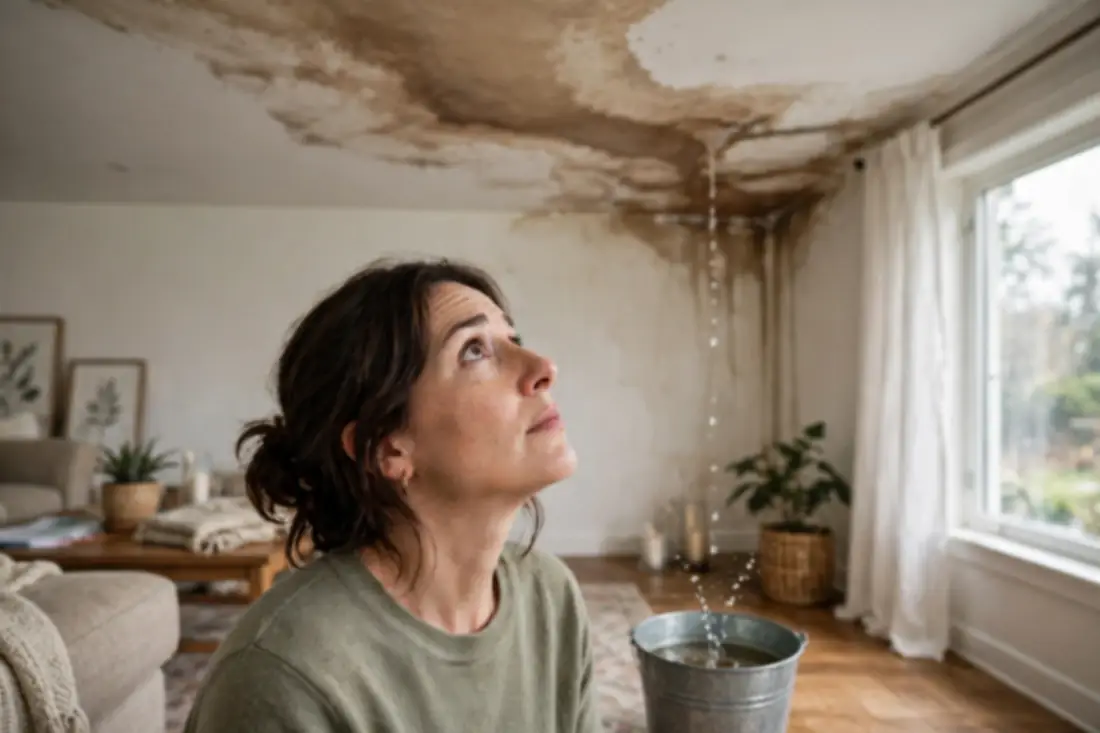
Few household moments scramble the brain like water arriving through the ceiling. The instinct is to do everything at once — climb somewhere, call someone, move everything. This guide slows the moment down into its working order: what to do in the first ten minutes, what to do in the first hour, and what genuinely helps the roofer who will solve it. Because a leak is two problems — the water in your house right now, and the opening in your roof that sent it — and they are worked in that order.
One Houston note before the steps: our rain does not do drizzle. A leak discovered during a Gulf downpour is being fed at a rate that makes the inside work urgent and the outside work impossible until the storm passes. Everything below respects that sequence.
Step One: Contain the Water (Minutes 0–10)
Get a container under the drip — a bucket or a stock pot — and drop a towel or a sponge into the bottom of it. The towel matters more than it sounds: a drip landing on a hard surface splashes a wide circle of secondary damage, and a drip landing on cloth lands quietly in one place. Move what the water can reach: furniture out of the circle, electronics unplugged and lifted, rugs rolled back, cardboard and paper goods off the floor.
If the ceiling itself is bulging, it is holding pooled water above the paint. That bulge is heavier and more fragile than it looks. Keep people and valuables out from under it and leave it alone — a controlled release is a professional's call, made from the attic side or not at all. What you should not do is climb into the attic or onto the roof during the storm: wet surfaces, hidden deck damage, and lightning make the diagnosis wait for safe conditions, every time.
Step Two: Document Like It Matters (Minutes 10–30)
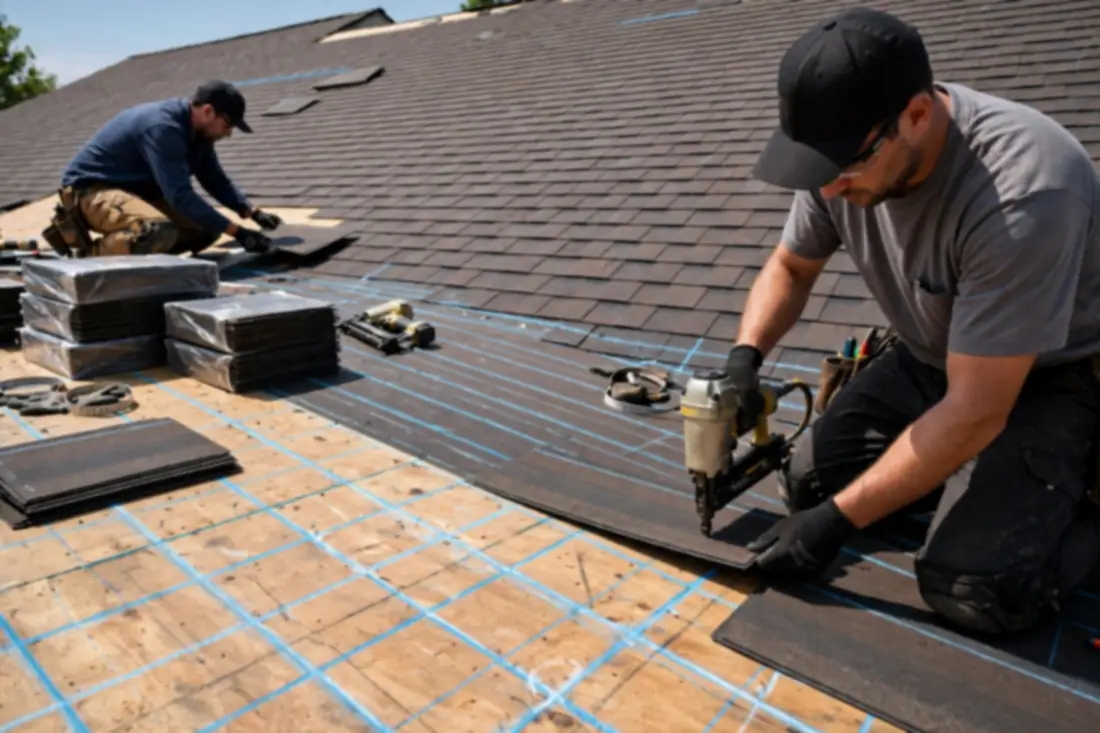
Photograph everything while it is happening: the drip in motion, the stain's size against something for scale, the bulge, the belongings in the water's path, and — from the ground, if it can be done without going outside into the worst of it — the roof's visible state. Note the time the leak started and what the weather is doing: raining hard, wind from which direction, or easing off. That weather note sounds small and is, in fact, the diagnostician's favorite sentence in your whole report.
Keep the documentation habit running after the rain stops. Photograph the stain again when it dries — its final outline is a map of the water's path — and save any shingle pieces or debris the storm left in the yard, in place, photographed before they are moved. Storms write evidence; homeowners who preserve it get sharper diagnoses and cleaner files.
Step Three: Read the Clues Your House Is Giving
While you wait for the weather and the roofer, your house is offering evidence worth collecting. Where exactly is the stain — which room, which position in the room, near an outside wall or mid-ceiling? Does the drip run only in hard rain, or in any rain? Did it begin with a particular storm, or has it crept in over a season? Each answer eliminates suspects: wall-adjacent stains point at flashing, mid-room stains at traveled water, hard-rain-only leaks at laps and overwhelmed valleys.
Resist one temptation: the stain's position is where the water exited your ceiling, almost never where it entered your roof. Water runs along decking and rafters from the entry point to the low seam where it drops — often several feet, sometimes rooms, away. That is why leak repair is a diagnosis discipline, and why sealant aimed at the ceiling's geography fails so reliably.
Step Four: The Call, and What Happens Next
Call and give the roofer the evidence in order: the room and position, when it started, what weather brings it, and what the storm left in the yard. That description is not small talk — it is the first half of the diagnosis, and it tells the professional which suspects to load for. Houston Roofing Help's line is staffed Mon–Fri 7 AM–10 PM, Sat 8 AM–10 PM, and Sun 7 AM–9 PM Central; one call connects you with a local roofing professional.
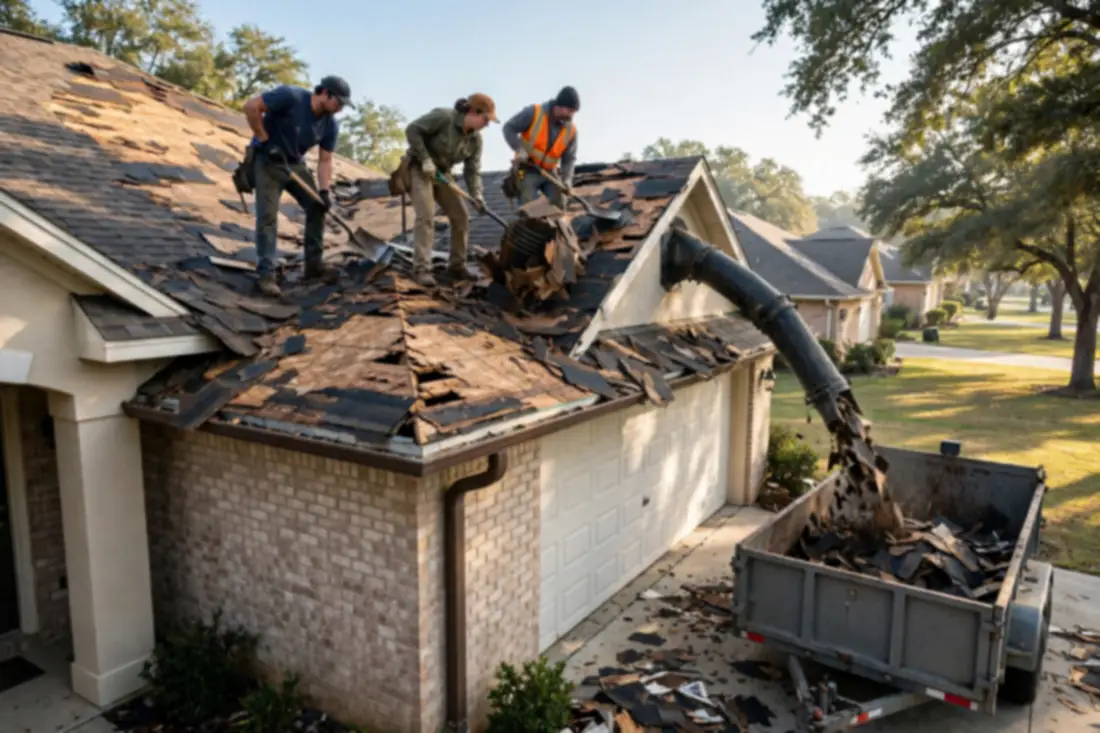
The visit itself works attic-first: the stain trails and moisture evidence under the roof point upslope to the entry suspects — a cracked boot, a separated flashing run, a dammed valley — which are then examined on the roof, and hose-tested if the answer stays ambiguous. The repair follows the diagnosis at the source layer. Then the proof: watch the old stain through the next rains. It should never perform again.